Planning An Extension? How To Choose The Right Doors Before You Build
Planning an extension is one of the most exciting ways to transform your home—but it’s also where a lot of people get caught out. Most focus on layout, finishes, and budgets first, and only think about doors much later. In reality, your choice of doors should be one of the earliest decisions you make, because it directly affects structure, flow, light, and how you actually use the space day to day.
Here’s how to think it through before the first shovel hits the ground.
Why Door Choice Should Influence Layout
It’s tempting to treat doors as a finishing touch—something you slot in once the walls are up. But in an extension, especially one opening onto a garden, doors are the feature. They define how the inside connects to the outside and often become the focal point of the entire space.
If you’re planning wide openings with lots of glass, that decision will shape everything else: wall lengths, kitchen positioning, where structural supports go, even how natural light moves through the room. A run of large sliding doors, for example, encourages a more linear layout, while bifold doors might push you toward a more flexible, open-plan arrangement.
Thinking about doors early also helps avoid awkward compromises later—like squeezing in smaller units than you really wanted because the structure won’t allow for anything bigger.
The Structural Considerations (Steel Supports, Opening Widths etc.)
Big, open apertures don’t just happen—they need serious structural support. The wider the opening, the more likely you’ll need steel beams (RSJs) to carry the load above.
This has a few knock-on effects. First, steel adds cost—not just for the material itself, but for installation, calculations, and inspections. Second, it influences ceiling height. Depending on how the beam is integrated, you might end up with a boxed-in section that slightly drops the ceiling line.
Opening width is another key factor. It’s easy to say “we want the whole wall to open,” but there are practical limits depending on your budget, the type of doors, and the structure of your home. Wider openings also mean heavier glass panels, which can affect the choice between bifold and sliding systems.
Getting a structural engineer involved early—and aligning their input with your door choice—can save a lot of redesign work later on.
Bifold Vs Sliding For Extensions
This is one of the biggest decisions you’ll make, and there’s no one-size-fits-all answer.
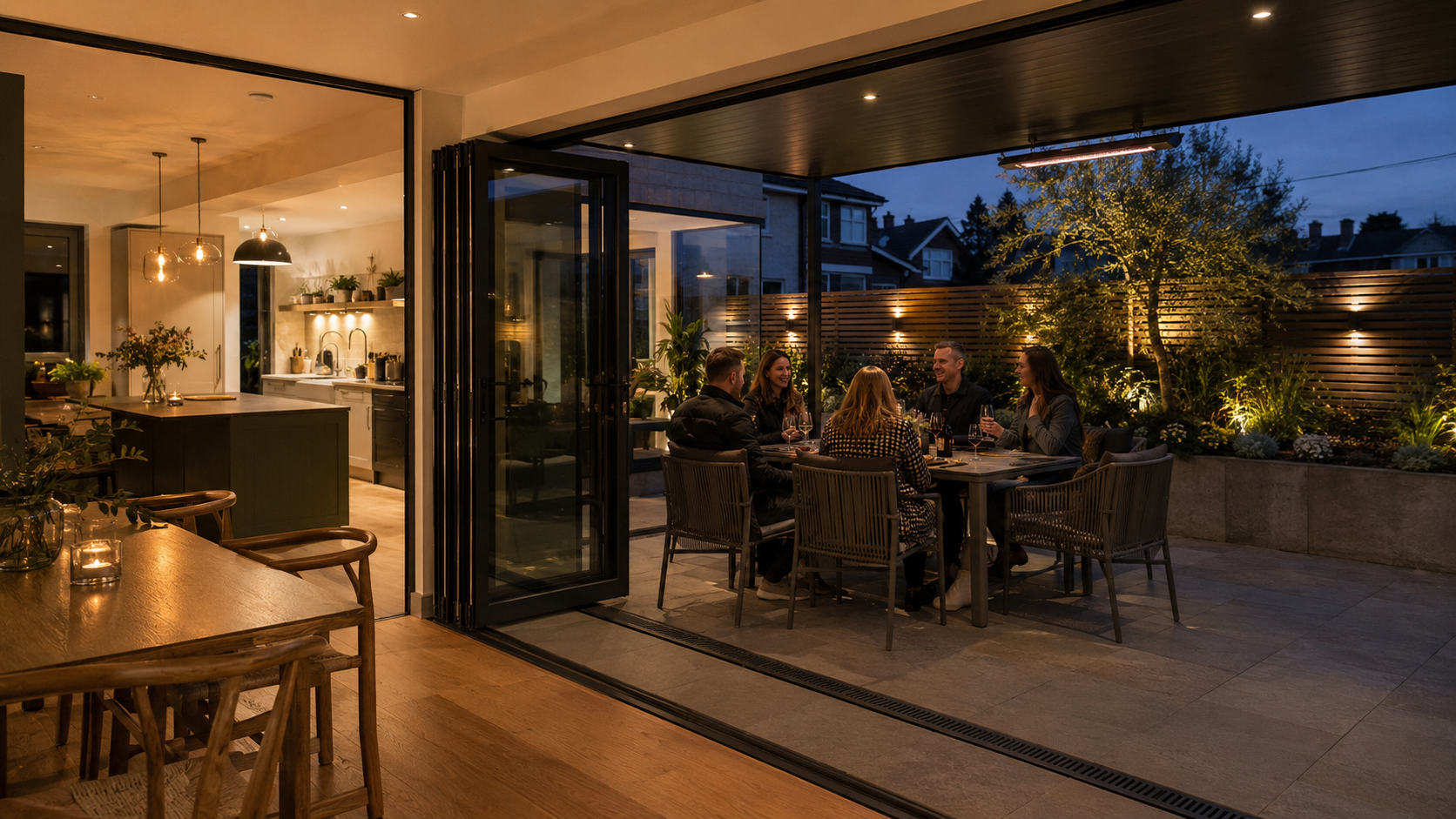
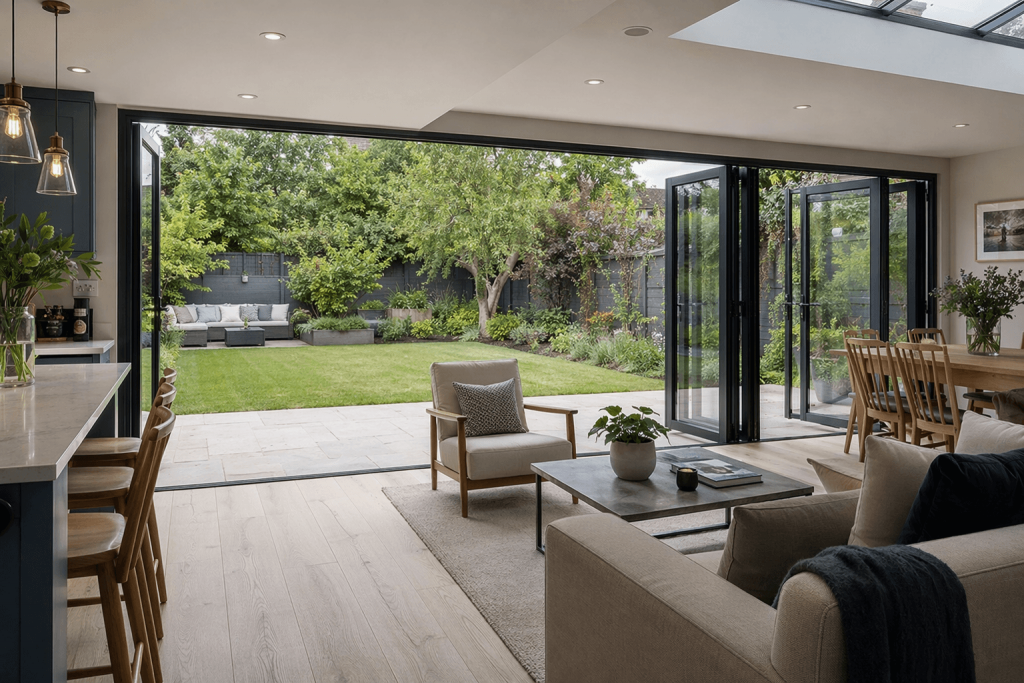
Bifold doors are popular because they can open up almost the entire width of the extension. When fully folded back, they create that “indoor-outdoor” feel people love. They’re great for entertaining and for homes where you want a seamless transition to the garden.
The trade-off is that when closed, bifolds tend to have more visible frames, which can interrupt views slightly. They also need space to stack when open, which can affect furniture placement.
Sliding doors, on the other hand, prioritise clean sightlines. With fewer frames and larger panes of glass, they let in more uninterrupted light and offer better views year-round. They’re ideal if your garden outlook is a key feature.
However, sliding doors never fully open—one panel always sits behind another—so you don’t get quite the same open-air effect as bifolds.
A good way to decide is to think about how you’ll use the space most of the time. If you value the view even when the doors are closed, sliding might win. If you picture summer days with the entire wall opened up, bifolds could be the better fit.
Sightlines And Furniture Placement
Doors don’t just affect how you move through a space—they shape what you see and where you can put things.
Large glazed doors draw the eye outward, so it’s worth considering what your sightlines will be. What do you see when you walk into the room? Where does your gaze naturally land when you’re sitting down? Positioning doors to frame the best parts of your garden can make a big difference.
Furniture layout is just as important. Bifold doors need clearance for opening panels, which can limit where you place sofas, dining tables, or kitchen islands. Sliding doors are less intrusive in that sense, but you still need to think about access points and how people will move in and out.
It’s surprisingly easy to design a beautiful space on paper that becomes awkward once real furniture is added. Mapping out door swings and walkways early helps avoid that.
Threshold Options (Flush Vs Raised)
The threshold—the point where inside meets outside—is a small detail that has a big impact.
Flush thresholds create a seamless transition, with little to no step between the interior floor and the patio. They look great and are ideal for accessibility, making it easier for children, older adults, or anyone with mobility needs.
The downside is that they require careful drainage design to prevent water ingress. This is especially important in the UK, where weather conditions can be unpredictable.
Raised thresholds are more traditional and provide an extra barrier against rain, but they do create a visible step. For some, that’s a worthwhile trade-off for peace of mind; for others, it interrupts the clean, continuous look they’re aiming for.
It’s worth discussing this with both your builder and door supplier to strike the right balance between aesthetics and practicality.
Ventilation Considerations
With large glazed doors, ventilation often gets overlooked—but it shouldn’t.
On hot days, especially in south-facing extensions, temperatures can rise quickly. While opening doors helps, it’s not always practical (or secure) to have them fully open all the time.
Trickle vents, tilt-and-turn panels, or integrating additional windows into the design can all help maintain airflow. Some sliding systems offer partially opening configurations, while bifolds can be set up to open just one panel like a standard door.
Cross-ventilation is another smart consideration. If you can create airflow from one side of the house to the other, the space will feel more comfortable year-round without relying entirely on mechanical cooling.
Future-Proofing Your Investment
An extension is a long-term investment, so it pays to think beyond your immediate needs.
Energy efficiency is a big one. High-quality glazing, good seals, and thermally efficient frames will make a noticeable difference to heating costs and comfort. Cheaper options might save money upfront but can cost more over time.
Durability and maintenance are also worth considering. Aluminium frames, for example, tend to be low-maintenance and long-lasting, while some other materials may require more upkeep.
Finally, think about how your needs might change. Will the space still work if your household grows, or if you use it differently in a few years? Choosing flexible door configurations and robust systems can help ensure your extension continues to serve you well into the future.
Remember that getting the doors right isn’t just about style—it’s about making the whole space work. By bringing that decision forward in the planning process, you’ll end up with an extension that feels more cohesive, more functional, and ultimately more enjoyable to live in.
Categories: Uncategorised